
China's AI Surge Puts Robots to Work — With Lessons for ASEAN
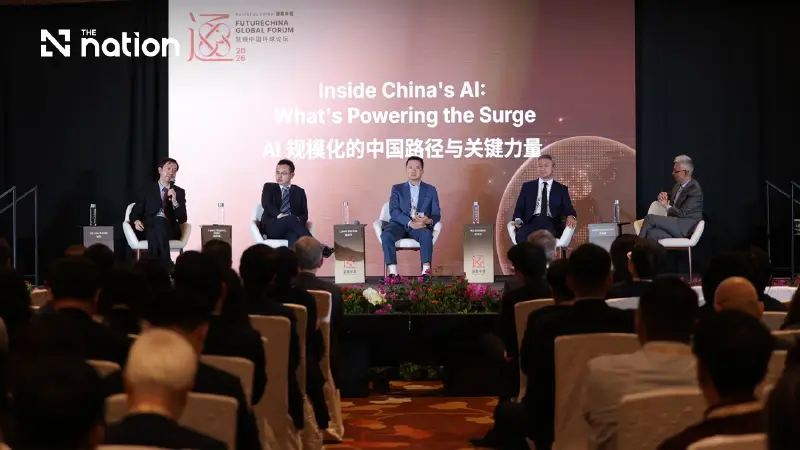


Singapore forum hears how China's AI agents, robots and cheap software are reshaping industry — and what it means for Thailand and the region
- Chinese firms are rapidly deploying AI-powered robots in practical roles like logistics and manufacturing, though experts at a Singapore forum noted the technology's overall economic penetration remains below 1%.
- The primary obstacle for advanced robotics is a lack of physical training data, but China's large-scale, real-world deployments are expected to create a long-term "data flywheel" advantage.
- For ASEAN nations like Thailand, the key lesson is to proactively engage with the influx of Chinese AI technology, which is set to disrupt regional supply chains and labor markets.
- The AI surge is expected to impact the workforce by benefiting junior, digitally-native employees who can leverage AI, while posing a challenge to white-collar professionals and senior engineers slower to adapt.
The Singapore forum hears how China's AI agents, robots and cheap software are reshaping industry—and what it means for Thailand and the region.
For Thai businesses watching China's artificial intelligence boom from across the South China Sea, a candid panel discussion in Singapore this week offered a rare, unvarnished look at what is actually driving the surge—and a caution against assuming the technology is more mature or more profitable than it really is.
The session, titled "Inside China's AI: What's Powering the Surge," opened the first day of the 17th FutureChina Global Forum, held on Thursday (September 24) under the theme "Strengthening Resilience, Rebuilding Trust."
The two-day event, running until Friday, is organised by Business China, a non-profit body founded by Singapore's first prime minister, Lee Kuan Yew, and regularly draws business leaders, officials and academics from China and Singapore to discuss economic and geopolitical trends.
This year, for the first time, the forum devoted an entire track to AI, spread across three panels examining the economics, infrastructure and governance of the technology. The relevance for Thailand and the wider ASEAN bloc is not abstract.
As Chinese firms push AI-powered robotics into logistics, manufacturing and services at a pace few Western competitors can match, Southeast Asian economies — many of which host Chinese factories, ports and increasingly, data centres — are being pulled into the same supply chains and labour disruptions the panellists described.

The forum also lands as China enters its 15th Five-Year Plan period (2026–2030), which places innovation, industrial upgrading and domestic demand at the centre of economic policy, developments Chinese officials say will shape opportunities across the region.
An economy still in its infancy, panellists insist
Moderated by Jiang Changjian, associate professor at Fudan University's School of International Relations and Public Affairs, the panel brought together Liang Xinjun, chairman and chief executive of Xin Family Pte Ltd; Shen Dou, executive vice-president of Baidu and president of Baidu AI Cloud Group; Wu Gansha, co-founder, chairman and chief executive of autonomous-driving firm UISEE Technology; and Yang Fengyu, founder and chief executive of robotics start-up UniX AI.
Liang, an investor with substantial AI holdings, opened by citing figures on the scale of the technology's adoption: tens of millions of "AI Agents" — software programmes capable of completing tasks independently — are already active worldwide, with forecasts suggesting that number could grow dramatically by 2030.
Yet he argued this masks how little AI has actually penetrated daily economic life.
"AI's penetration into the economy and into daily life is still under one per cent," Liang told the audience, pushing back against talk of a bubble.
He acknowledged that current returns on AI investment likely still lag behind the capital pouring into the sector but predicted the gap would close "within three to five years" as cash flows from AI applications accelerate.

Pricing for large language models will keep falling, he said, but that does not mean the technology has plateaued — there remains substantial room for models to become more capable, particularly outside China's dominant consumer applications.
Robots at work, but the economics are still hard
The most concrete illustrations of China's AI push came from the robotics floor rather than the boardroom.
Wu Gansha of UISEE Technology described the rapid scaling of autonomous ground vehicles deployed at a major Chinese airport for tasks such as baggage handling and tarmac operations in extreme summer heat — conditions, he noted, that are gruelling for human workers but pose no problem for machines that "don't call in sick, don't get tired, and only draw one salary."
Deployment, he said, went from a single unit in 2023 to a handful in 2024 before jumping to roughly twenty units in 2025 — a trajectory he attributed to the robots proving their worth by solving genuine operational problems rather than serving as novelties.

Yang Fengyu of UniX AI, whose company builds wheeled robots equipped with dual robotic arms rather than bipedal humanoid designs, argued that the physical form factor matters less than economics.
Bipedal humanoid robots remain expensive and largely confined to walking and balancing, he noted, with few genuinely useful manipulation tasks yet proven at scale.
His own robots, by contrast, are already deployed in retail, hospitality, and office environments performing real commercial jobs. Pressed on what is really holding "embodied AI" back, the panellists converged on one answer: not algorithms, not even computing power, but data.
Unlike large language models, which can be trained on vast troves of internet text, humanoid and industrial robots lack anything close to internet-scale data on physical movement and manipulation.
"Algorithms aren't the problem, computing power isn't the problem — data is the biggest problem," Fengyu stated.
However, Gansha countered that China's unmatched richness of real-world deployment scenarios gives it a distinct edge.
While Fengyu acknowledged that the United States currently holds a head start built over decades of accumulated robotics hardware data, both panellists agreed that China's expanding base of deployed robots and manufacturing environments will eventually build a "data flywheel" to turn data into a long-term advantage.

Software struggles to catch up
The conversation, guided by panel moderator Changjian, addressed a persistent structural challenge in China's technology ecosystem: the historic undervaluation of enterprise software compared to hardware and semiconductor stocks.
Examining this gap, Xie Xin, president of ByteDance’s enterprise collaboration platform Feishu, reflected on his firm's strategic pivot from a free model to a paid subscription structure in 2020.
He emphasised that building a viable enterprise software business required steadfast conviction that corporate clients would pay once products delivered tangible productivity gains.
He added that while spending on integrated AI features currently accounts for a modest portion of overall revenue, it is expanding rapidly, predicting that enterprise investment in AI capability will soon surpass expenditure on the baseline software platform itself.

Who wins, who loses
Turning to the labour market consequences of widespread AI adoption, panellists rejected simplistic assumptions regarding workforce displacement.
Fengyu, who entered the industry alongside the launch of ChatGPT, argued that entry-level, digitally native workers often stand to gain the most. He noted that junior professionals equipped with an AI-native mindset can automate up to ninety percent of complex software coding tasks within days, whereas some senior engineers lag behind by treating advanced models merely as glorified search engines.
Conversely, Xie Xin observed that knowledge workers and general white-collar staff face immediate operational disruption as model capabilities transition from simple information retrieval to complex problem-solving.
Addressing students in the audience, the panellists offered actionable guidance on navigating an AI-driven job market. Xie Xin urged students to thoroughly master the mathematical and theoretical foundations of large models while in university, warning that few professionals find time for structured academic study after entering the workforce.
Gansha advised young professionals never to treat AI as an answer generator but rather as an objective tool to rigorously critique their own reasoning.
Building on this, Fengyu underscored that while artificial intelligence can readily perform ninety-five percent of a technical task, the decisive final margin of quality ultimately hinges on human logic, empirical testing, and critical judgement.

Singapore as a bridge and a message for the region
Expanding on international dynamics, Xinjun of Fosun Group highlighted Singapore's strategic positioning within the global AI landscape.
He emphasised that despite its small geographic footprint, Singapore ranks among the top five global cities for both computing infrastructure and talent density, making it an ideal neutral bridge linking Chinese application scenarios and engineering talent with Western capital and compute power.
For Thailand and its ASEAN neighbours, this cross-border integration carries direct strategic implications as Chinese technology companies increasingly export AI-powered robotics from firms like UniX AI and UISEE alongside enterprise platforms like Feishu.
The region's role as a proving ground, consumer market, and eventual competitive hub is set to expand rapidly.
Whether this shift yields new capital investment and productivity gains or accelerates the displacement of entry-level positions will depend on how proactively regional governments and business leaders engage with the dynamics outlined by the panellists, rather than waiting passively for the technology to mature.

