
Anutin says Thailand will not choose sides but must keep options open
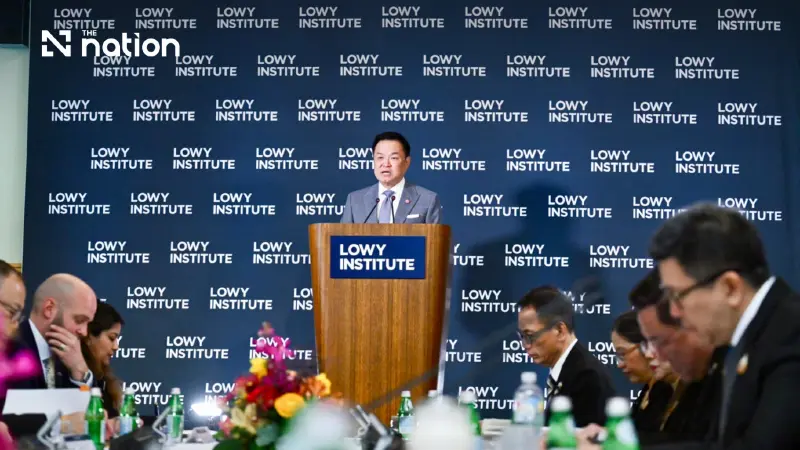


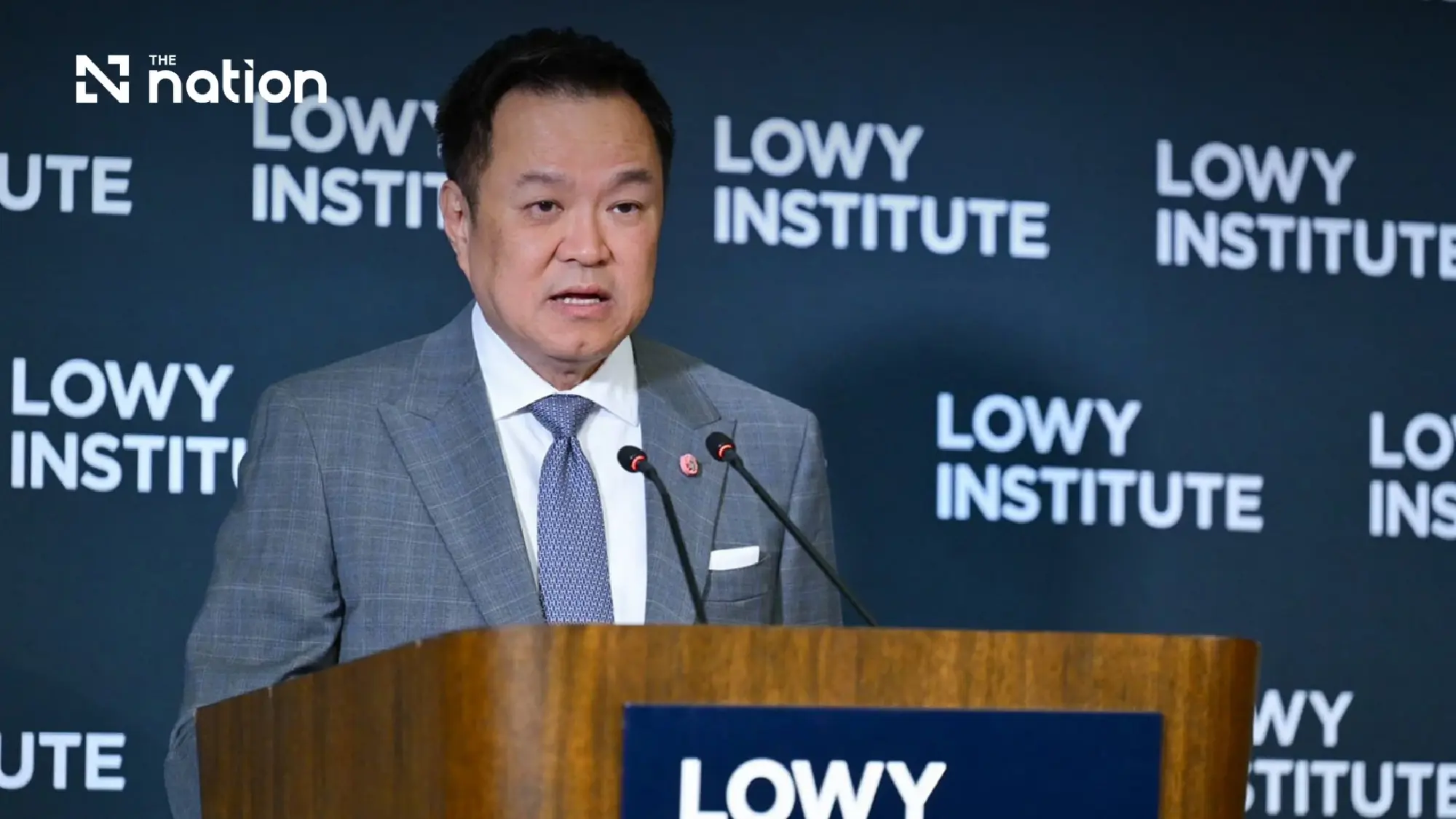
Anutin Charnvirakul told the Lowy Institute that Thailand would preserve strategic autonomy through regionalism, wider partnerships and deeper economic ties.
- Prime Minister Anutin Charnvirakul stated that Thailand will pursue a policy of "strategic autonomy," meaning it will not choose sides in global power competitions but will preserve its ability to make independent decisions.
- To keep its options open, Thailand will diversify its international relationships by strengthening regional institutions like ASEAN and engaging in flexible, smaller-scale "minilateral" cooperation with various partners.
- A key part of this strategy is building economic resilience through deeper integration and diversifying trade and supply chains to avoid over-dependence on any single country.
Prime Minister and Interior Minister Anutin Charnvirakul has set out Thailand’s approach to an increasingly uncertain international order, stressing that the country does not need to choose sides but must preserve its ability to make independent decisions and maintain a range of strategic options.
Anutin delivered an address entitled “Beyond the Thailand-Australia Bilateral Partnership: Advancing International Order through Regional and Minilateral Cooperation” at the Lowy Institute in Sydney at 10.20am local time on Tuesday (August 18), three hours ahead of Thailand.
Dr Michael Fullilove, executive director of the Lowy Institute, welcomed the prime minister to the independent Australian international-policy think tank, whose global analysis and indexes are cited by governments and media organisations worldwide.

Government spokesperson Ratchada Thanadirek said Anutin used the address to present Thailand’s perspective to Australia’s foreign-policy and strategic community, focusing on how Thailand, Australia and other middle-sized countries could respond to a more unpredictable world.
He proposed three main approaches: making regionalism more effective in addressing current challenges, preserving strategic autonomy and building resilience through deeper economic integration.

Partnership should extend beyond bilateral relations
Anutin noted that his visit came at an important moment, ahead of the 75th anniversary of diplomatic relations between Thailand and Australia in 2027.
He argued that the two countries should build on their strategic partnership by moving beyond bilateral cooperation and contributing more broadly to the region.
Geopolitics, economics and technology were becoming increasingly interconnected, while strategic competition and conflict were directly affecting trade, investment, supply chains, energy and food security, he said.
With the international system becoming more uncertain and difficult to predict, Thailand and Australia shared an interest in maintaining an open, stable and rules-based international environment.
Anutin stressed that every country had a role in preserving such a system and that the responsibility should not rest solely with the major powers.
Regional institutions must deliver practical results
The first approach proposed by the prime minister was to make regionalism more capable of responding effectively to current challenges.
Global institutions remained extremely important, he said. However, when achieving consensus at the global level became more difficult, regional institutions had to assume a greater role in maintaining channels for dialogue, building trust and translating principles into practical action.
For Thailand, ASEAN remained a vital “strategic anchor”.
Over several decades, the regional grouping had helped transform Southeast Asia from a region marked by division and mistrust into one characterised by increasing dialogue, cooperation and integration.
However, ASEAN must continue evolving, Anutin argued. Its unity and centrality needed to be supported by the ability to set its own agenda and respond effectively to regional challenges.

Thailand backs ASEAN plan and calibrated Myanmar engagement
On Myanmar, Anutin reaffirmed Thailand’s support for ASEAN’s Five-Point Consensus alongside “calibrated re-engagement”, involving appropriate and gradual interaction to keep communication channels open and encourage tangible progress.
He noted that Myanmar authorities had recently allowed a representative of the International Committee of the Red Cross to meet Aung San Suu Kyi, a development that Thailand had consistently promoted.
Thailand hoped the meeting would lead to further positive developments, he added.
Regarding relations with Cambodia, Anutin maintained that Thailand remained committed to resolving problems peacefully through dialogue and bilateral mechanisms mutually accepted by both sides, while preserving ASEAN unity.
Although the circumstances surrounding Myanmar and Cambodia were different, he said the underlying principle remained the same: regional mechanisms must help member states manage their differences while preserving space for continued cooperation.

Strategic autonomy does not mean isolation
Anutin’s second proposal was to preserve strategic autonomy by expanding and diversifying international partnerships.
He explained that strategic autonomy did not mean separating a country from others or adopting a neutral position on every issue.
Instead, it meant retaining the capacity to make independent decisions, define national choices, work with a diverse range of partners and assess each matter according to facts and the national interest.
The more constructive relationships countries developed with different partners, the more options they would have and the less likely they would be to face pressure to follow a course serving another country’s interests.
Anutin described this as an area in which Thailand and Australia could deepen their cooperation.
He praised Australia as ASEAN’s first dialogue partner and noted its continued support for ASEAN centrality and an open and inclusive regional architecture.
Australia had also played an important role through its cooperation with ASEAN, the Mekong-Australia Partnership and its expanding economic relationship with Southeast Asia.
Smaller groups could respond more quickly
Thailand and Australia should also expand results-oriented cooperation through smaller groupings, known as minilateral cooperation, Anutin said.
Such arrangements could respond more quickly and practically to urgent and specific challenges.
One important example was cooperation against online and transnational crime.
Anutin and Australian Prime Minister Anthony Albanese were scheduled to sign a joint statement on cooperation against transnational crime in Canberra, with the aim of strengthening law-enforcement cooperation between the two countries.
Anutin said this approach was about allowing countries to determine their own direction without having to choose a side or join a particular camp.
Instead, countries should build coalitions and networks that expanded opportunities for practical cooperation.
Resilience should not lead to economic fragmentation
The prime minister’s third proposal was to build resilience through deeper economic integration.
At a time when international interdependence could become a source of vulnerability, resilience should not mean dividing or fragmenting the global economy, he said.
Instead, countries should diversify risk and avoid excessive dependence on any single source without undermining the economic openness that had formed an important foundation for regional prosperity.
Thailand and Australia already had a strong economic foundation.
The Thailand-Australia Free Trade Agreement has been in force since 2005, while bilateral trade was valued at approximately A$32 billion in 2025.
The ASEAN-Australia-New Zealand Free Trade Area and the Regional Comprehensive Economic Partnership had further connected the two countries with the wider regional economy.
Thailand seeks a more resilient economic partnership
Anutin said the next step should be to transform the economic relationship into a “resilient partnership” capable of adapting to change.
Australia had strengths in critical minerals, energy, education, technology and capital, while Thailand offered capabilities in advanced manufacturing, food production and regional connectivity, alongside expanding green and digital industries.
The two countries should combine those strengths across sectors including critical minerals, batteries and future vehicles, clean energy and advanced manufacturing.
Other promising areas included food security, agricultural technology, digital trade, cybersecurity and the responsible development of artificial intelligence.
Thailand’s accession process for the Organisation for Economic Co-operation and Development would also play an important role in raising standards, improving regulations and promoting innovation-led economic growth, Anutin said.
He expressed Thailand’s appreciation for Australia’s support during the accession process.
Countries must help shape the future international order
Anutin concluded that the world could not fully recreate the international system of the past.
All countries must contribute to building an international order for the future by developing partnerships that preserve strategic choices and pursuing economic integration that strengthens resilience.
“Thailand and Australia may not be countries that determine the global balance of power, but we can help shape how power is exercised in our region,” he said.
The prime minister called for a renewed Thailand-Australia strategic partnership that would strengthen bilateral relations while helping preserve a rules-based, open, inclusive and resilient region.
Such cooperation would support lasting peace, stability and prosperity for the people of both countries and the region as a whole, he added.
