
IMF chief warns of debt, energy and AI risks before Bangkok talks



IMF chief Kristalina Georgieva warns that high debt, costly energy and an uneven AI boom pose major risks as global policymakers prepare to meet in Bangkok.
The global economy faces a difficult combination of record public debt, persistently high energy costs and both the opportunities and risks created by artificial intelligence, IMF Managing Director Kristalina Georgieva warned ahead of next week’s IMF-World Bank Annual Meetings in Bangkok.
Georgieva delivered her 2026 Annual Meetings Curtain Raiser speech in Singapore on Wednesday (October 7), setting out the main economic issues expected to confront finance ministers and central bank governors when they gather in Thailand from October 12–18.

Asia-Pacific takes larger role in global economy
Georgieva highlighted the rapid rise of the Asia-Pacific region since Thailand last hosted the IMF-World Bank Annual Meetings in 1991.
The region’s share of global GDP has increased from about 25% to 43%, underscoring Asia’s growing importance to global growth, trade and financial stability.
Against that backdrop, she identified three major forces shaping the global outlook: the rapid expansion of AI, prolonged high energy prices and mounting public debt.
“The global economy is being pulled in two opposite directions,” Georgieva said, describing a negative energy supply shock alongside a positive demand shock from AI.
Wars in Ukraine and the Gulf are adding to economic damage, particularly for countries heavily dependent on imported energy, while the AI investment boom is providing a new source of demand and economic activity.

AI emerges as powerful but uneven growth engine
AI is becoming an increasingly important driver of investment and trade.
Georgieva said investment in AI as a share of global GDP could eventually exceed the relative scale of previous infrastructure booms involving railways, electricity grids and telecommunications networks.
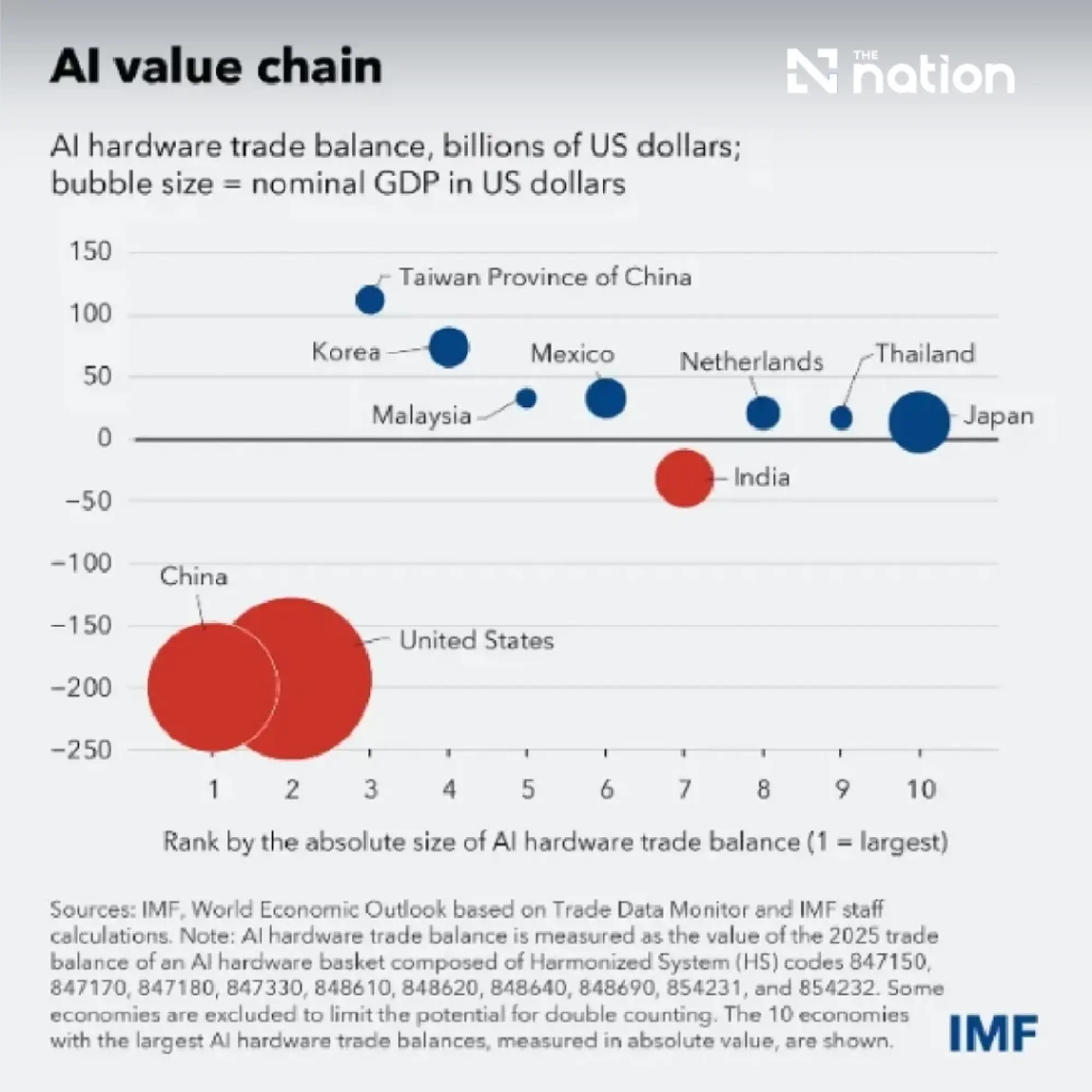
AI hardware and related technology products already account for more than 10% of world goods trade, with the United States, China and India among the major net importers as they build AI infrastructure.
Of the other seven economies among the world’s top 10 players in AI-related trade, five are Asian suppliers, highlighting the region’s strong position in technology supply chains.
However, Georgieva warned that the benefits are highly concentrated and could widen inequality if many countries are unable to gain access to the technology and the infrastructure needed to use it.
AI also brings financial risks. Heavy investment has increased pressure on technology companies to deliver the productivity and earnings expected by markets, meaning disappointment could trigger wider financial shocks.
Despite those risks, IMF research suggests that AI, if managed effectively, could add around 0.5 percentage point to annual global growth — an increase that Georgieva compared with adding an economy roughly the size of ASEAN to the world economy over time.

Energy shock adds to inflation pressures
The AI boom is also increasing demand for electricity and other energy resources at a time when global fuel supplies remain under pressure.
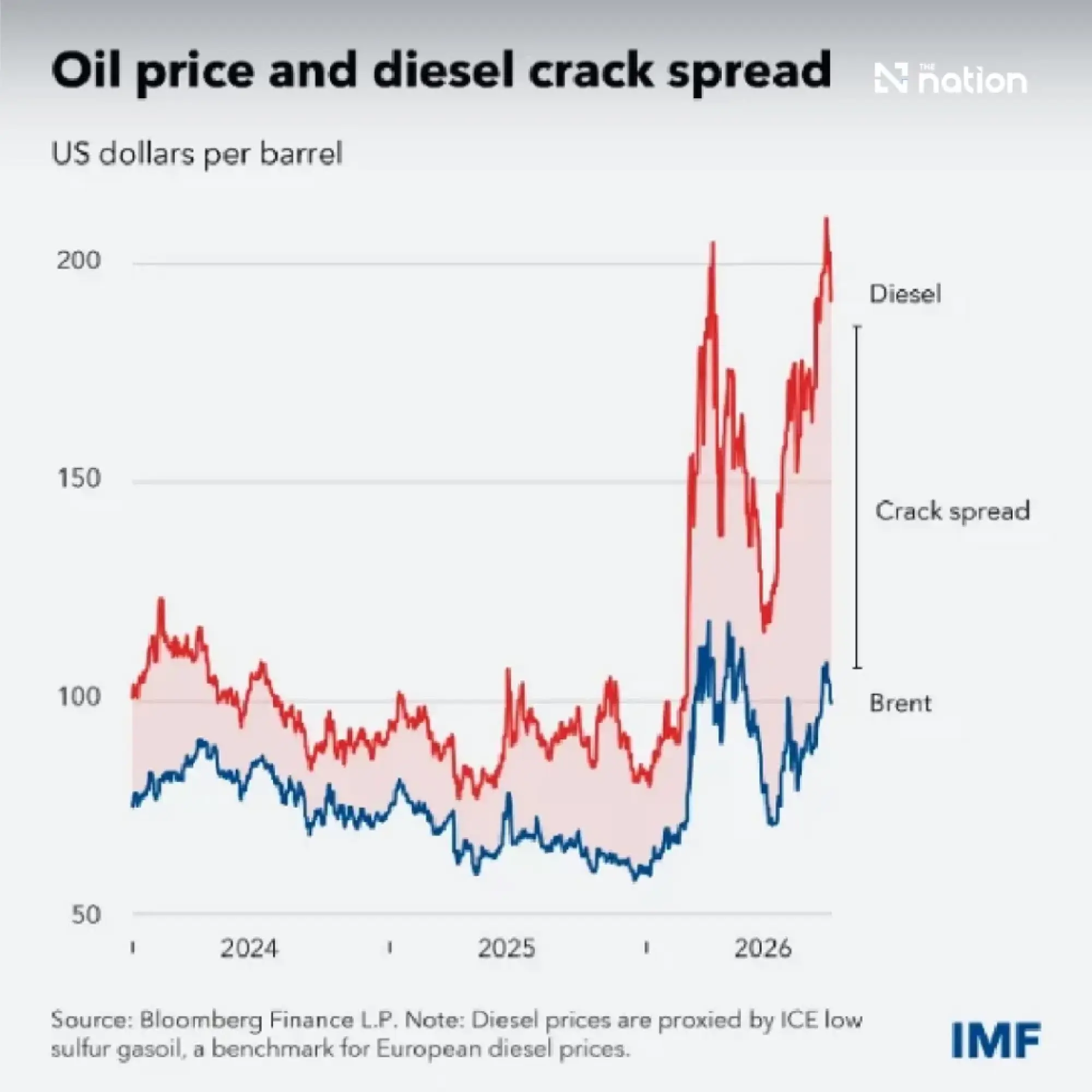
Georgieva said crude oil prices remained around US$100 a barrel, while constraints on global refining capacity had added roughly another US$100 a barrel in refining margins for important products including diesel, pushing some refined fuel prices to record levels.
Liquefied natural gas supplies have also been disrupted by risks to shipping through the Strait of Hormuz, with Asia and Europe particularly exposed.
Food, fertiliser and industrial input costs are also under pressure, while adverse weather poses an additional threat to food security.
With the Northern Hemisphere heading towards its colder months and countries expected to rebuild energy stocks, Georgieva borrowed a line from Game of Thrones: “Winter is coming.”
She warned that high energy prices could persist even if the Gulf conflict eased, with oil futures pointing to elevated prices through 2027.

Global public debt heads above 100% of GDP
Higher energy costs are feeding into inflation, policy interest rates and government borrowing costs.
Georgieva noted that 10-year sovereign bond yields in the United States, Germany and Japan had risen to their highest levels since 2007, 2009 and 1996, respectively.
Meanwhile, global public debt is approaching levels not seen since the aftermath of the Second World War and is projected to exceed 100% of global GDP before 2030.
Advanced economies carry some of the largest debt burdens, while emerging markets and low-income countries face their own difficulties as borrowing costs rise relative to revenue and economic growth.
Georgieva warned that governments could no longer rely solely on faster economic growth to bring debt ratios down, particularly after years in which interest rates were generally lower than economic growth rates.
She called for credible medium-term fiscal consolidation, particularly in highly indebted advanced economies, while stressing that governments should explain why fiscal adjustment is necessary, minimise damage to future growth and protect vulnerable groups.
Her message to policymakers gathering in Bangkok was clear: “We cannot keep delaying necessary policy action — you have the tools, now have the wisdom to use them.”
IMF urges ‘prudently hawkish’ monetary stance
Georgieva also said many central banks may need to maintain a “prudently hawkish bias”, with inflationary pressures coming not only from energy and food but also from the AI investment boom, tariffs, defence spending and high public debt.
She described recent rate increases by the US Federal Reserve, European Central Bank and Bank of Japan as appropriate responses to persistent inflation risks.
At the same time, she warned that financial regulators need to closely monitor the AI-driven market boom, as high valuations and growing leverage could amplify any disappointment in technology-company earnings.
Structural reforms needed alongside fiscal repair
Georgieva said fiscal restraint and monetary policy alone would not be enough to address the world’s longer-term economic challenges.
Governments should also pursue reforms aimed at improving workforce skills, increasing labour-market flexibility, making it easier for businesses to enter and leave markets, expanding access to long-term capital, strengthening energy security and reducing unnecessary bureaucracy and outdated regulation.
International cooperation will also be essential if the benefits of AI are to spread beyond the economies currently leading the technology boom.
“In our interconnected world, countries cooperate not out of charity but out of self-interest,” Georgieva said.
The issues raised in Singapore are expected to form part of the wider debate when policymakers from the IMF’s member countries gather in Bangkok next week to discuss the global outlook, financial stability and policies for sustaining growth amid rising geopolitical, technological and fiscal pressures.
