
Face masks: An environmental time bomb
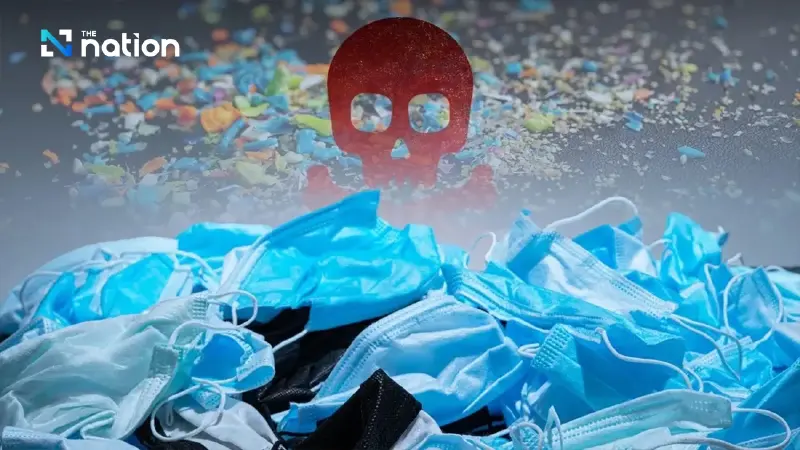


Billions of discarded face masks are breaking down into microplastics and releasing toxic chemicals into the environment, accumulating in the food chain. This poses a long-term threat to biodiversity and human health.
Since the onset of the Covid-19 pandemic, face masks have become an essential tool for personal protection. However, along with their widespread use, billions of discarded masks have accumulated in both landfills and waterways.
Scientists are now warning that used face masks are an "environmental time bomb" that are breaking down into "microplastics" and continuously releasing harmful chemicals.
At the height of the pandemic, an estimated 129 billion disposable face masks were used globally each month, most made from polypropylene and other plastics. Due to the lack of recycling programs, most of these masks were either buried in landfills or discarded in public spaces such as streets, parks, beaches, water bodies, and rural areas.
These masks are now beginning to decompose, releasing microplastics into the environment.
Research by Dr Anna Bogush and Dr Ivan Kourtchev from the Centre for Agroecology, Water, and Resilience at Coventry University shows that even unused masks can pollute water sources. This has raised concerns about the environmental cost of single-use face masks.

Invisible Pollution from Face Masks
To simulate real-world conditions, the researchers placed unused face masks into a 150ml beaker filled with distilled water and left them at room temperature for 24 hours. The water was then filtered and analysed using advanced laboratory techniques, with strict controls to prevent contamination.
The findings revealed that even without wear or heavy use, the masks still released measurable amounts of microplastics and chemicals into the water. This discovery indicates that pollutants are embedded in the manufacturing process and can be leached into the environment with minimal contact.
What is particularly concerning is that FFP2 and FFP3 dust-filtering masks release 4 to 6 times more microplastic particles than regular disposable face masks.
The microplastics found varied significantly in size, ranging from 10 to 2,082 micrometres, but particles smaller than 100 micrometres were most commonly found in the water samples.
The most prevalent material was polypropylene, the plastic widely used in mask production. Additionally, traces of polyethene, polyester, nylon, and PVC were detected. These materials are highly durable and almost impossible to degrade naturally.
This means that these substances will persist in the environment for decades. When consumed by marine life or other organisms, these materials can accumulate through the food chain, ultimately posing a threat to biodiversity and potentially harmful to human health.
Chemical Contaminants in Medical Masks
The researchers also uncovered a more alarming finding. Through chemical analysis of water containing used face masks, it was revealed that medical masks release bisphenol B, a hormone-disrupting chemical that is toxic to aquatic life. If these chemicals seep into water bodies in large quantities, they could contaminate drinking water sources, increasing risks to both humans and wildlife.
Considering the mass production of disposable masks during the height of the pandemic, the researchers estimated that these masks led to the release of 128-214 kilograms of bisphenol B into the environment.
Scientists Warn of Long-Term Health and Environmental Risks from Face Masks
Scientists are warning that the combined impact of microplastics and chemical leaching from disposable face masks remains poorly understood but could have severe consequences for human health.
While these particles are extremely small, their massive quantities and slow decomposition pose a long-term environmental danger.
"We cannot overlook the environmental impact of single-use face masks, especially knowing that the microplastics and chemicals they release can harm both humans and ecosystems. Moving forward, it is crucial to raise awareness of these risks, support the development of more sustainable alternatives, and make informed decisions to protect both our health and the environment," said Dr Bogush.
The Need for Sustainable Alternatives
The research underscores the urgent need to rethink the use and disposal of single-use face masks. Experts stress the importance of developing sustainable alternatives, such as reusable masks made from biodegradable materials. Equally important is raising public awareness about the hidden dangers of single-use protective gear.
"As we move forward, it is vital that we create awareness of these risks, support the development of more sustainable alternatives, and make informed decisions to protect both our health and the environment," Dr Bogush added.
While face masks remain essential in preventing diseases, their environmental impact must not be ignored. It is necessary to consider safer designs and better waste management systems to prevent long-term damage to the planet.
Kritpol Sutheepatrakul
